
Emotions Academy Enrichment Program
from emotions
to outcomes
The only enrichment program built for out-of-school time that teaches kids emotional resilience and gives you the data to prove it.
- Kids stay engaged — and keep coming back
- Any facilitator can run it. No teaching degree required.
- Funder-ready outcome data built into every session
- Students leave with coping skills they actually use in real life
- Students Supported • Teachers Equipped • Outcomes Measured
Running an enrichment
program has never been harder
Kids arrive carrying whatever happened at school. Your facilitators are part-time and under-trained. Your funder wants impact data. And attendance only holds if kids actually want to come back.
Kids are showing up dysregulated from the school day — and we’re expected to turn it around in two hours with no support.
My facilitators aren’t teachers. I can’t hand them a complex program and expect consistent delivery.
My grant renewal is in 90 days and I have no data to show what this program actually did for kids.
If it’s not engaging, kids stop coming. Attendance is how we survive — and nothing we’ve tried keeps them hooked.
You’re being asked to deliver developmental impact — with part-time staff, limited time, and funders who want proof. Most programs were never built for that reality.
Emotions Academy Was.
Most programs teach emotions.
Emotions Academy builds resilience.
There’s a big difference. Here’s why it matters for your program.
Typical Programs

Deliver content, then call it a day.
Heavy prep burden on already-stretched staff
Passive learning that doesn’t transfer to real life
No way to measure whether any of it worked
Students disengage after week two
Emotions Academy

Structured lesson flow facilitators can run confidently
Multi-modal activities that keep kids moving and engaged
Portable coping skills students take and actually use
Built-in measurement that shows funders real impact
Joyful by design, because kids learn what they love
Every lesson follows the same proven
four-step flow.
No guesswork. No improvising. Facilitators run it. Students own it.
Build Awareness
Open discussion that connects the topic to students’ real lives. They talk. They listen. They feel seen.
Engage the Whole Child
Hands-on activities that activate body, mind, and emotion. This is where learning becomes felt, not just heard.
Practice with Real Scenarios
Students apply skills to real-life situations — not hypotheticals. This creates transfer beyond the classroom.
Anchor a Coping Skill
Every lesson closes with one portable coping skill the student owns — something they can use tomorrow, anywhere.
Real skills. Not just vocabulary.
Students don’t just learn to name emotions. They learn to work with them.
Regulate in Real Time
Calm their body when it’s activated. Tools that work in the moment — not just in a counselor’s office.
Build Empathy & Connection
Strengthen peer relationships and learn how emotions affect the people around them.
Make Better Decisions Under Pressure
Choose their response — not just react. The skill that changes behavior at school and beyond.

FIVE MODULES. ONE JOURNEY.
Each module builds on the last — moving students from self-discovery to emotional mastery to character strength.
A HERO’S JOURNEY: DISCOVERING MY STRENGTHS
Build identity, confidence, and self-awareness. Students learn who they are — and why that matters.

THE ROLE OF EMOTIONS: WHO’S AT THE WHEEL?
Understand emotions and their influence on choices. Students discover they have more agency than they think.
THE POWER OF THOUGHTS: CHOOSE YOUR THOUGHTS WISELY
Learn how thinking patterns shape outcomes. Identify unhelpful patterns and replace them with constructive ones.
CALMING STRATEGIES: THE POWER IS YOURS
Develop a personal toolkit of body-based regulation tools that work in real life — not just in theory.
CHARACTER BUILDERS: COMPASSION, FORGIVENESS, GRATITUDE
Build identity, confidence, and self-awareness. Students learn who they are — and why that matters.
A HERO’S JOURNEY: DISCOVERING MY STRENGTHS
Build identity, confidence, and self-awareness. Students learn who they are — and why that matters.
THE ROLE OF EMOTIONS: WHO’S AT THE WHEEL?
Understand emotions and their influence on choices. Students discover they have more agency than they think.
THE POWER OF THOUGHTS: CHOOSE YOUR THOUGHTS WISELY
Learn how thinking patterns shape outcomes. Identify unhelpful patterns and replace them with constructive ones.
CALMING STRATEGIES: THE POWER IS YOURS
Develop a personal toolkit of body-based regulation tools that work in real life — not just in theory.
CHARACTER BUILDERS: COMPASSION, FORGIVENESS, GRATITUDE
Build identity, confidence, and self-awareness. Students learn who they are — and why that matters.

Built to be easy. Designed to scale.
Your facilitators are part-time, high-turnover, and not credentialed teachers. Emotions Academy was designed for exactly that reality.
Any facilitator can run it — from day one
College student, paraprofessional, community volunteer. If they can follow a structured flow, they can deliver Emotions Academy with confidence.
Zero prep. Just show up and run it.
Every lesson is fully built. No planning time, no materials to source, no guesswork. Turnover doesn’t break your program.
Fits your schedule — not the school day
Designed specifically for afterschool, summer, and expanded learning time. Flexible session structure works around your program.
Grant-ready data, automatically captured
Outcome reports you can drop directly into your funder narrative. No extra paperwork. No scrambling at renewal time.
DIGITAL PROGRAM
Ready-to-run lessons. Minimal prep. Instant access to outcome data.
DIGITAL + CRAFT EXPERIENCE
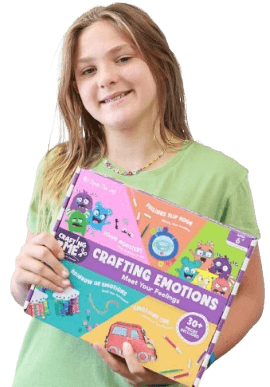
Combine digital with craft-based activities for deeper engagement and stronger retention.
Who Emotions Academy is built for.

After School Programs
Summer Camps
21st Century / ELOP
Community Youth Orgs
Students were not only engaged — they were applying the strategies immediately.
EMOTIONAL RESILIENCE. MADE FUN. MADE BETTER.
Your program deserves more than a good intention. It deserves proof. Give your students the skills, your facilitators the structure, and your funders the data they're asking for.